
THE GOOD NEWS:
Research shows some minerals, herbs, and other nutrients can dramatically improve prostate health and reduce prostate cancer risk!
THE BAD NEWS:
Most supplements contain the wrong form of key nutrients… AND… New research shows that the most popular herb for prostate problems, saw palmetto, may actually damage healthy prostate tissue!
Avoid Saw Palmetto to Maintain Prostate Health
Sooner or later most men will have prostate problems … but you don’t have to join the club. You can prevent prostate problems before they even begin … and alleviate uncomfortable prostate symptoms quickly and safely, with a superb nutritional supplement.!
How much do you know about the prostate gland?
Most men know more about a woman’s monthly cycle than they do about their own reproductive system. Yet, prostate problems are just as common in men as PMS is in women. And although a staggering 12 million men suffer from an enlarged prostate, most can’t even begin to describe what the gland exactly does. According to a 2001 survey conducted by Rodale’s Men’s Health magazine, twenty-one percent of males actually believe both men and women have a prostate
What does the prostate gland do, anyway?
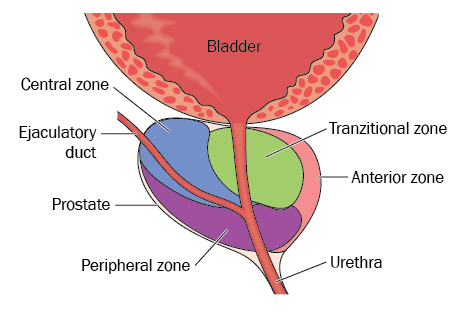
The prostate is the size and shape of a walnut and is located under the bladder and directly in front of the rectum. It secretes a thin, milky, alkaline fluid that:
- Provides about half the fluid in semen
- Helps transport sperm by providing a protective alkaline escort through the acidic regions of the vagina and cervix
- Helps moisten the lining of the urethra
What causes prostate problems?
After about age 40, the prostate begins to grow in just about every male. Sometimes the enlargement is a sign of cancer, but usually the result is a condition called benign prostatic hyperplasia. Most doctors refer to an enlarged prostate simply as BPH.
In some men, the prostate gland enlarges without causing urinary problems—probably because their urethra is wider than average, or because the gland tends to enlarge outward. In most men, however, as BPH develops, the prostate presses against the neck of the bladder or urethra, squeezing the pipe shut, like stepping on a garden hose. This pressure can make it difficult to urinate and results in a variety of symptoms.
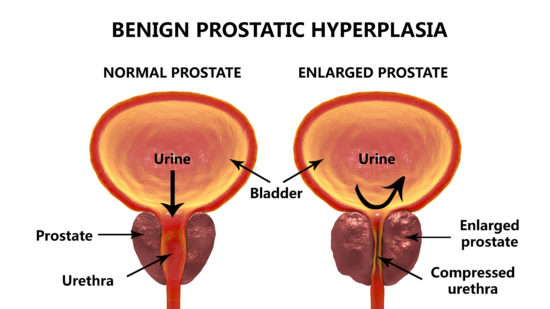
Also, the bladder wall becomes thicker and irritable. The bladder begins to contract even when it contains small amounts of urine, causing more frequent urination. Eventually, the bladder weakens and loses the ability to empty itself. Urine remains in the bladder. The narrowing of the urethra and partial emptying of the bladder cause many of the problems associated with BPH, including:
- Urgency—the need to go immediately
- During urination, there is a thin stream of urine that stops and starts instead of a full, steady stream
- Hesitancy or difficulty starting urine flow
- Dribbling after urinating
- Nocturia — having to get up frequently at night to urinate
- Increased frequency of urination
- Increased risk of infection if the bladder does not empty entirely and urine is retained
Why does BPH occur in the first place?
Although the exact cause isn’t known, there are a few theories. First of all, we’ve known for centuries that BPH occurs mainly in older men and that it doesn’t develop in men whose testes were removed before puberty. For this reason, researchers believe that factors related to aging and the testes may spur the development of BPH.
Maintain Testosterone for Prostate Health
Men produce both testosterone, an important male hormone, and small amounts of estrogen, a female hormone. As men age, the amount of active testosterone in the blood decreases, leaving a higher proportion of estrogen. One theory, based on animal studies, suggests that BPH may occur because the higher amount of estrogen within the gland increases the activity of substances that promote cell growth.
Another theory focuses on dihydrotestosterone (DHT), a substance derived from testosterone in the prostate, which may help control its growth. Most animals lose their ability to produce testosterone as they age. However, some research has indicated that even with a drop in the blood’s testosterone level, older men continue to produce and accumulate high levels of DHT in the prostate. This accumulation of DHT may encourage the growth of cells. Scientists have also noted that men who do not produce DHT do not develop BPH.
Some researchers suggest that BPH may develop as a result of “instructions” given to cells early in life. According to this theory, BPH occurs because cells in one section of the gland follow these instructions and “reawaken” later in life. These “reawakened” cells then deliver signals to other cells in the gland, instructing them to grow or making them more sensitive to hormones that influence growth.2
What causes prostate cancer?
Like other cancers, the cause is unknown. But it seems to be linked to increasing age—most likely because the prostate gland enlarges with each passing year. Some research suggests that prostate cancer is linked to diet and environment: men who eat fruits, vegetables and whole foods rich in lycopene and selenium, have lower rates of cancer than those who eat a poor diet high in saturated animal fats and red meat. Also, Asians in China and Japan typically have low rates of prostate cancer. But when they immigrate to the US and change their eating habits, they get it at the same rate as other Americans.
Your genes play an important role, too. If the disease runs in your family, you’ve got a one-in-four chance of developing it yourself.
Why is the incidence of prostate cancer increasing?
One reason is that we’re living longer. In the early 20th century, men usually died from pneumonia, tuberculosis, or other infectious diseases. According to Tom Sansone, urologist at Bryn Mawr Hospital in Pennsylvania, autopsies of 40-year-old men show that a fifth have signs of cancer. By age 70, about 65 percent of men have cancerous cells in their prostate glands. And by age 80, a man’s chance of prostate cancer rises to one in three. So, if you don’t succumb to heart attack or stroke, and keep on living to a ripe old age, there’s a very good chance you’ll end up with prostate cancer.
Also, we’re living in a toxic world. Alternative Medicine (The Burton Goldberg Group, Future Medicine Publishing, Inc. 1997) reports that there are higher rates of prostate cancer in men who work with batteries3, and men who work in the petrochemical, rubber, and textile industries.4 And urban areas have higher incidences as opposed to rural, which is thought to be due to air and other pollution.5
(See Smart Publications article, The Key to Survival in a Toxic World)
Unlike BPH, prostate cancer may not give symptoms in its early, curable stage, which is why it’s important to get a PSA (Prostate Specific Antigen) test each year starting in your 40s, in which the blood is analyzed for evidence of cancer.
The surprising truth about why the popular herb saw palmetto might not be the best way to maintain prostate health.
Unless you already have prostate cancer, do not take saw palmetto because it may cause cellular damage and death in healthy prostate cells!!
Saw palmetto is good stuff … if you have prostate cancer!
More than 20 controlled double-blind studies have demonstrated that saw palmetto berry extract (containing 85-95% fatty acids and sterols) is effective in relieving the major symptoms of BPH, including increased night-time urinary frequency, the most bothersome complaint.6
For years nobody knew exactly how saw palmetto worked, but we now know that it shrinks the prostate gland by killing prostate cells—both malignant and healthy cells. Surprisingly, while saw palmetto is selectively toxic to prostate cells and prostate cancer cells, it has not been researched as a treatment for prostate cancer. The big question is, “Should saw palmetto be used as a preventative supplement if it actually works by poisoning the prostate gland?”
Important information about saw palmetto!
Three recent studies investigating the effectiveness and effect of saw palmetto on prostate tissue came up with the same conclusion: Saw palmetto has an effect similar to chemotherapy on prostate cells—it kills both unhealthy and healthy cells!
Up until now, saw palmetto extract has been the supplement of choice in the treatment of BPH. Saw palmetto is very good at helping to shrink overgrown prostate tissues, and it was thought to reduce the level of DHT by blocking its receptor sites in the prostate and by inhibiting enzymes necessary for DHT conversion.
-Sponsored Ad-
Save 25% to 50% on ProstaE8
Prostate Protection Formula
Unfortunately, 3 recent surprising scientific studies indicate saw palmetto may work, but also harm your prostate health!
- One study examined the effect of saw palmetto on stroma cells—the framework cells that build supportive tissue — and on epithelial cells —those which line the glands and ducts of the prostate. The study was done on normal prostate tissue and on BPH tissues from patients treated with and without the saw palmetto. The conclusion was that saw palmetto damages the nuclear and mitochondrial membranes, and causes cellular death in the epithelium and stroma.7
- Another study investigated the effects of saw palmetto on primary cultures of fibroblasts (cells that produce connective tissue), and epithelial cells from the prostate, epididymis (the tube that provides for the storage, transmission and maturation of sperm), testes, kidney, skin and breast to determine if the action of saw palmetto is selective and specific to prostate tissue. This study concluded that saw palmetto caused damage and death in prostate tissue, but there were no similar changes observed in other types of cells.8
- This study examined the effect of saw palmetto on benign prostatic hyperplasia (BPH). Again, the results showed there was widespread damage of intracellular membranes, including mitochondrial and nuclear membranes in both healthy and overgrown prostate tissue.9
Because of this new information, it seems prudent to avoid saw palmetto extract as a preventative supplement for prostate health. Saw Palmetto may eventually turn out to be an effective way to kill prostate tumor cells, but its toxicity to healthy prostate cells is reason enough to be concerned about taking saw palmetto daily as a means of preventing prostate problems.
Current studies indicate that about 12 million men in the United States alone are affected by BPH.
You don’t have to be one of them. Even if you’re not experiencing symptoms, it’s never too early to support and tone your glandular tissues and help regulate hormonal imbalances.
Comprehensive prostate care
Fortunately, researchers and medical professionals from around the world are reporting encouraging data on “male” nutritional supplements in addition to saw palmetto—and their effectiveness in supporting prostate health. But most supplements sold in the US don’t measure up to the European pharmaceutical standards and aren’t nearly as effective.
The Ultimate Prostate Protection Plan
Want to reduce your cancer risk? Want relief from BPH? You can with these 10 proven nutrients! Nutritional supplements can offer many of the same therapeutic benefits for treatment of genitourinary tract disorders as drug therapy … without any of the side effects!
Key nutrients and herbal extracts provide prostate support
The prevention of prostate cancer and BPH has been shown to be related to dietary intakes of some key nutrients, and several herbal extracts also can strongly influence prostate problems. BPH and cancer are very treatable health conditions. But a lot of formulas do not contain high quality ingredients. It’s very important, however, that the particular herbal extracts and nutrients are of the highest quality available and meet European pharmaceutical standards.
We, at Smart Publications, have reviewed all the literature on nutritional prevention and treatment for BPH and prostate cancer. In this body of research, there are many natural substances that have positive effects on prostate health. However, we were not satisfied with a suggestive study or two. We looked hard and selected the following 10 items based on the following criteria:
- There had to be a significant number of studies indicating positive prostate health effects and the studies had to be independently replicated.
- We had to be convinced about the safety based on a long history of traditional use of the substance by humans or long history of scientific investigation or both.
Here’s what we found:
- Boron – According to a study done last year at UCLA, men with the highest boron intake were 65 percent less likely to develop prostate cancer than men with the lower boron intake. The researchers compared dietary patterns of 76 men with prostate cancer to that of 7,651 males without cancer. Men in the lowest quartile of boron consumption ate about one slice of fruit per day, while those in the highest quartile ate 3.5 servings of fruit per day. The researchers found that boron’s cancer-fighting effects seem to be specific for prostate cancer. Foods that are high in boron include: red wine, raisins, peanuts, apples, pears, peaches, oranges, grapes, lima beans, and peanut butter.10
- Daidzein – is an isoflavone found in soybeans, legumes and peas. Soy isoflavones are free radical scavengers (potent antioxidants) and are antiangiogenic (interfere with unwanted blood vessel growth in disease states). They have been shown to have a beneficial effect on various types of cancer.In countries like Japan, where soy consumption is high, there is approximately an 80 percent lower incidence of prostate cancer than in the West. In a study that followed Japanese men who immigrated to the United States and abandoned their traditional diets, it was found that within one generation, there was a four-fold to nine-fold increase of prostate cancer among them.11 But, unfortunately, the main isoflavone in soy, genistein, actually seems to have undesirable toxic effects. Only now is pure daidzein, the other isoflavone in soy, available as a supplement.Daidzein doesn’t share genistein’s toxic properties, and was demonstrated to be very protective against prostate cancer in a study showing that peas dramatically reduce risk of prostate cancer. Peas contain a lot of daidzein, but not genistein.12
- Grape seed extract – contains proanthocyanidins, potent antioxidants that may lower the risk of cancer. In a recent study, grape seed extract was used to inhibit cell growth in human cancerous prostate cells. The results suggest that grape seed antioxidant proanthocyanidins may exert a strong anticarcinogenic effect against prostate cancer by inhibiting abnormal cell growth and promoting tumor cell death.13
- Green tea – Next time you eat at a Japanese or Chinese restaurant, order a pot of green tea! It not only tastes good, but scientists have observed that people who consume tea regularly have a lower risk of prostate (and breast) cancer-related deaths. In fact, the incidence of prostate cancer in China, a population that consumes green tea on a regular basis, is lowest in the world.14 And sure enough, recent studies done both on human cells and mice, have shown that green tea’s polyphenol—epigallocatechin-3-gallate—blocks the growth of prostate cancers.151617
- Lycopene – Have you had your tomato sauce today? This member of the family of phytochemicals known as carotenoids, is a powerful antioxidant that is found in red fruits and vegetables, especially tomatoes, watermelon, red grapefruit, and guava. Researchers have linked the frequent use of lycopene from tomatoes to a lower risk of prostate and other cancers.18 Interestingly, in one study, researchers found that significantly lower serum and tissue lycopene levels were observed in the cancer patients than in their control group, indicating that lycopene prevents oxidative damage of biomolecules and consequently reduces the risk of prostate cancer.19
- Vitamin E – is a major antioxidant nutrient that helps maintain healthy membranes and retards cellular aging due to oxidation. It is especially important to sexual and reproductive health. One study that followed more than 29,000 male Finnish smokers, ages 50 to 69, for five to eight years, showed that vitamin E reduces the risk of prostate cancer.20Our diets contain mostly the gamma tocopherol form of vitamin E. Most dietary supplements contain only alpha tocopherol, not gamma tocopherol. Unfortunately, high intakes of alpha tocopherol actually pushes the preferred gamma form of vitamin E out of the body. And since the most current research shows it is gamma tocopherol that is associated with a reduction of prostate cancer—especially when combined with selenium and alpha tocopherol 21 —make sure you take a supplement that contains gamma and alpha, not just alpha tocopherol!21
- Selenium – There have been many studies showing a direct connection between selenium and prostate cancer, and most nutritionist agree, it’s hard to get enough of it on a daily basis without taking a nutritional supplement. In the now famous Clark Study, a 63% reduction in prostate cancer was found in men who received 200 micrograms of selenium from a selenium-enriched yeast containing mostly selenomethionine. The conclusion? Eat more tuna, Brazil nuts, and sunflower seeds, and to guard against gaps in your diet, take a daily supplement containing 200 micrograms of selenium from selenium-enriched yeast or selenomethionine!22Another study conducted at Stanford University found that low plasma selenium is associated with a 4 to 5-fold increased risk of prostate cancer. These results support the hypothesis that supplemental selenium may reduce the risk of prostate cancer. And because plasma selenium decreases with patient age, supplementation is particularly beneficial to older men.23
- Kohki leaf– If you have problems with an overactive bladder—a common and annoying BPH complaint—this nutrient will help cut down your trips to the bathroom! Unlike other compounds, Kohki actually prevents the adverse changes in the bladder that often accompany prostate problems. Kohki comes from a subtropical plant that grows wild in southern China. It has been used medicinally in East Asia for hundreds of years and is sold over the counter today in Japan as a medicinal tea. It contains strong antioxidants, including several dihydroflavonol glycosides, that have been shown to have a significant protective effect on bladder function.24
- Pygeum africanum – is an evergreen tree that grows in the mountainous forests of Africa. Unfortunately it has become an endangered species due to its popularity as a european pharmaceutical for prostate problems. Luckily, high quality extract is still being produced using farmed trees grown on plantations for medicinal use. This bark extract has been prescribed by European doctors for years, both to help preserve prostate health and promote a man’s overall well being. Pygeum not only helps common prostate problems but also promotes prostate function. Unlike saw palmetto, it is not toxic to prostate cells and is even an antioxidant. It contains a variety of active compounds that synergistically aid prostate health. Many studies have shown the effectiveness of Pygeum extract in treating BPH, including reduction of the frequency of nighttime urination25; and relief of symptoms associated with genito-urinary problems resulting from BPH.26
- Nettle root – commonly known as stinging nettles, you may have had the experience of walking through a field of this plant in Great Britain. Unpleasant, yes! But if you want to prevent or relieve reduced urinary bladder capacity, urinary outflow, and residual urine flow, the extract made from the root of this medicinal plant will help do the trick. It is well documented and recognized, especially in Europe, to relieve symptoms of BPH2728. Just make sure you’re using nettle root and not nettle leaf, which is used to alleviate arthritis symptoms, not prostate problems.
IMPORTANT NOTE about European Medicinal Herbs like Saw Palmetto, Pygeum, and Nettle:
While these 3 herbal extracts are successfully used in European countries for prostate problems as pharmaceuticals, and much of the impressive research has utilized these pharmaceutical grade extracts, MOST of the herbs sold in the United States DO NOT meet these exacting standards. To be sure you get outstanding results ONLY purchase products that use European Pharmaceutical Grade extracts of these three medicinal herbs.
Frequently asked questions
What’s a PSA test?
PSA stands for prostate-specific antigen, a protein made by the prostate gland. It’s a simple blood sample that measures the level of the protein. In general, a PSA under 4 ng/ml (nanograms per milliliter) is considered low, 4 to 10 is moderately elevated, and over 10 is considered high. Keep in mind, though, that prostate cancer isn’t the only thing or even the most likely thing that can cause PSA levels to rise. An enlarged prostate can also boost scores. It’s important to have a digital rectal exam along with the PSA.
What’s a digital rectal exam like?
According to Tom Sansone, M.D., urologist at Bryn Mawr Hospital, says, “For a really vigorous exam, go to a urologist, Family practitioners tend to be more gentle and superficial.” An urologist will manipulate the gland for a full minute, exerting pressure in order to feel for nodules, areas of hardness, changes of consistency and symmetry. A normal prostate should have two symmetrical lobes and the consistency of a rubber ball. If it’s so hard that the doctor can’t indent it with his thumb, then he knows there’s a problem.
Can I still have sex with an enlarged prostate?
Yes, in fact, the more sex the better! Regular sex, or at least ejaculation, is beneficial since it gets the juices flowing and clears out the ducts.
If I have an enlarged prostate, will I develop prostate cancer?
Not necessarily. According to Ronald L. Hoffman, M.D., Medical Director of the Hoffman Center in NYC and host of “Health Talk”, a syndicated radio program, “It is very common to have prostate enlargement without cancer. In fact, prostate enlargement is virtually universal among North American men, while prostate cancer is not. Nevertheless, it’s estimated that the vast majority of men may have ‘microfoci’ of cancer: tiny clusters of cancer cells that are normally of very little consequence, because they are slow growing. But some of them can develop down the line.” (Conscious Choice, June 1999)
References
- American Cancer Society
- The National Kidney and Urologic Diseases Information Clearinghouse (NKUDIC), a service of the National Institute of Diabetes and Digestive and Kidney Diseases (NIDDK); part of the National Institutes of Health under the U.S. Department of Health and Human Services.
- Smith, D.R., M.D. General Urology. 11th ed. Lost Altos, CA: Lange Medical Publications, 1982.
- Smith, D.R., M.D. General Urology. 11th ed. Los Altos, CA: Lange Medical publications, 1984. Kruzel, T. “What is the Prostate and Why is it Doing This to Me?” Health Review Newsletter (Aug. 1991).
- Ibid.
- Murry, M.T.: “Saw Palmetto: Nature’s Answer for Benign Prostate Enlargement.” Let’s Live, July 1996, 72-73;83
- Vacherot F, Azzouz M, Gil-Diez-De-Medina S, Colombel M, De La Taille A, Lefrere Belda MA, Abbou CC, Raynaud JP, Chopin DK. “Induction of apoptosis and inhibition of cell proliferation by the lipido-sterolic extract of Serenoa repens (LSESr, Permixon in benign prostatic hyperplasia.” Prostate 2000 Nov 1;45(3):259-66
- Bayne CW, Ross M, Donnelly F, Habib FK. “The selectivity and specificity of the actions of the lipido-sterolic extract of Serenoa repens (Permixon) on the prostate.” J Urol 2000 Sep;164(3 Pt 1):876-81
- Bayne CW, Donnelly F, Ross M, Habib FK. “Serenoa repens (Permixon): a 5alpha-reductase types I and II inhibitor-new evidence in a coculture model of BPH.” Prostate 1999 Sep 1;40(4):232-41
- Zhang, Z.-F., et al. 2001. Boron is associated with decreased risk of human prostate cancer. Abstract 834.3. Experimental Biology 2001 Meeting. March 31-April 4. Orlando.
- Shimizu H, et al. “Cancers of the breast and prostate among Japanese and white immigrants in Los Angeles County.” Br J Cancer1991;63:963-966.
- Key TJ, Silcocks PB, Davey GK, Appleby PN, Bishop DT. “A case-control study of diet and prostate cancer.” Br J Cancer1997;76(5):678-87
- Agarwal C, Sharma Y, Agarwal R. “Anticarcinogenic effect of a polyphenolic fraction isolated from grape seeds in human prostate carcinoma DU145 cells: modulation of mitogenic signaling and cell-cycle regulators and induction of G1 arrest and apoptosis.” Mol Carcinog 2000 Jul;28(3):129-38
- Gupta S, Ahmad N, Mukhtar H.. “Prostate cancer chemoprevention by green tea.” Semin Urol Oncol 1999 May;17(2):70-6
- Gupta S, Hastak K, Ahmad N, Lewin JS, Mukhtar H. “Inhibition of prostate carcinogenesis in TRAMP mice by oral infusion of green tea polyphenols.” Proc Natl Acad Sci U S A 2001 Aug 28;98(18):10350-5
- Gupta S, Ahmad N, Mukhtar H. “Prostate cancer chemoprevention by green tea.” Semin Urol Oncol 1999 May;17(2):70-6
- Paschka AG, Butler R, Young CY. Induction of apoptosis in prostate cancer cell lines by the green tea component, (-)-epigallocatechin-3-gallate. Cancer Lett 1998 Aug 14;130(1-2):1-7
- Giovannucci E, Rimm EB, Liu Y, Stampfer MJ, Willett WC. “A prospective study of tomato products, lycopene, and prostate cancer risk.” J Natl Cancer Inst 2002 Mar 6;94(5):391-8
- Rao AV, Fleshner N, Agarwal S. “Serum and tissue lycopene and biomarkers of oxidation in prostate cancer patients: a case-control study.” Nutr Cancer 1999;33(2):159-64
- Journal of the National Cancer Institute, 1998, vol. 90, no. 6
- Helzlsouer KJ, Huang HY, Alberg AJ, Hoffman S, Burke A, Norkus EP, Morris JS, Comstock GW. Association between alpha-tocopherol, gamma-tocopherol, selenium, and subsequent prostate cancer. J Natl Cancer Inst 2000 Dec 22;92(24):2018-23
- Yoshizawa K, Willett WC, Morris SJ, Stampfer MJ, Spiegelman D, Rimm EB, Giovannucci E. Study of prediagnostic selenium level in toenails and the risk of advanced prostate cancer. J Natl Cancer Inst1998 Aug 19;90(16):1219-24
- Brooks JD, Metter EJ, Chan DW, Sokoll LJ, Landis P, Nelson WG, Muller D, Andres R, Carter HB. “Plasma selenium level before diagnosis and the risk of prostate cancer development.” J Urol 2001 Dec;166(6):2034-8
- Levin RM, Kawashima Y, Leggett RE, Whitbeck C, Horan P, Mizutani K. Effect of oral Kohki tea on bladder dysfunction induced by severe partial outlet obstruction. J Urol 2002 May;167(5):2260-6
- Menchini-Fabris G. F. et al.: Nuove prospettive di impiego del Pygeum africanum nella patologia prostato-vesicolare. Arch.It.Urol.LX (1988) 313-322
- Doufour B. et al.: Etude controlee des effets de l’extrait de Pygeum africanum sur les symptomes fonctionneles de l’adenome prostatique,Ann. Urol 18 (1984) 193-195
- ESCOP: Monograph: Urtica radix (Nettle Root) European Scientific Cooperative on Phytotherapy. Elburg (1996)
- Vontobel, H.P.; Herzog, R.:Kreis, H.: Ergebnisse einer Doppelblindstudie uber die Wirksamkeit, von ERU-Kapseln in der konservativen Behandlung der benignen Prostatahyperplasie. Urolge{A{ 24 (1985) 49-51